
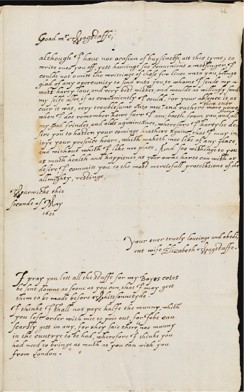
We are looking for enthusiastic undergraduates and postgraduates from any discipline to take part in workshops in textual editing culminating in the publication of a citable transcription.
Sign up for a workshop: see below for details.
We are pleased to announce the fourth year of Bodleian Student Editions workshops, a collaboration between the Bodleian’s Department of Special Collections and Centre for Digital Scholarship, and Cultures of Knowledge, a project based at the Faculty of History.
There will be 6 standalone workshops taking place in the year 2019-20, two per term. Workshops are held in the Weston Library’s Centre for Digital Scholarship. Dates for each term will be announced in that term, and are as follows:
Michaelmas Term 2019
- 10:00–16:30 Wednesday 3rd week, 30 October
- 10:00–16:30 Thursday 7th week, 28 November
Hilary Term 2020 To be announced in Hilary
- 10:00-16:30 Wednesday 3rd Week, 5th February
- tbc
Trinity Term 2020 To be announced in Trinity
- tbc
- tbc
Textual editing is the process by which a manuscript reaches its audience in print or digital form. The texts we read in printed books are dependent on the choices of editors across the years, some obscured more than others. The past few years have seen an insurgence in interest in curated media, and the advent of new means of distribution has inspired increasingly charged debates about what is chosen to be edited, by whom and for whom.
These workshops give students the opportunity to examine these questions of research practice in a space designed around the sources at the heart of them. The Bodleian Libraries’ vast collections give students direct access to important ideas free from years of mediation, and to authorial processes in their entirety, while new digital tools allow greater space to showcase the lives of ordinary people who may not feature in traditional narrative history.
Our focus is on letters of the early modern period: a unique, obsolescent medium, by which the ideas which shaped our civilisation were communicated and developed. Participants will study previously unpublished manuscripts from Bodleian collections, working with Bodleian curators and staff of Cultures of Knowledge (http://www.culturesofknowledge.org), to produce a digital transcription, which will be published on the flagship resource site of Cultures of Knowledge, Early Modern Letters Online (http://emlo.bodleian.ox.ac.uk), as ‘Bodleian Student Editions’.
The sessions are standalone, but participants in previous workshops have gone on to further transcription work with Bodleian collections and with research projects around the country, as well as producing the first scholarship on some of the manuscripts by incorporating material in their own research (from undergraduate to doctorate level). The first-hand experience with primary sources, and citable transcription, extremely useful for those wishing to apply for postgraduate study in areas where this is valued: one participant successfully proceeded from a BA in Biological Sciences to an MA in Early Modern Literature on the basis of having attended.
The sessions provide a hands-on introduction to the following:
- Special Collections handling
- Palaeography and transcription
- Metadata curation, analysis, and input into Early Modern Letters Online
- Research and publication ethics
- Digital tools for scholarship and further training available
You can read about research conducted in previous workshops here.
Participation in the workshops is open to undergraduate and graduate students currently enrolled at the University of Oxford in any subject and year, full-time or part-time. Eligibility includes visiting students who are registered as recognized students, and paying fees, but does not include informal visitors, postdoctoral researchers, or staff.
If you would like to participate, please contact Francesca Barr, Special Collections Administrator, francesca.barr@bodleian.ox.ac.uk, and include:
- your ox.ac.uk email address
- your department
- your level and year of study
- particular access requirements
- particular dietary requirements
Please note that owing to the workshops regularly being oversubscribed, we can only confirm places on this term’s workshops. You may register your interest in subsequent workshops, and will be notified of the dates for each term before they are advertised more widely.
The Bodleian Libraries welcome thoughts and queries from students of all levels on ways in which the use of archival material can facilitate your research. For an idea of the range of collections in the Weston, visit our current exhibitions in Blackwell Hall. Thinking 3D: Leonardo to the Present, in the Treasury gallery, tells the story of the development of three-dimensional communication over the last 500 years, showcasing techniques that revolutionised the dissemination of ideas in anatomy, architecture and astronomy and geometry and ultimately influenced how we perceive the world today. Talking Maps in the ST Lee Gallery is a celebration of maps and what they tell us about the places they depict and the people that make and use them. Drawing primarily on the Bodleian’s own unparalleled collection of more than 1.5 million maps – including the Gough Map (the first to show Great Britain in recognizable form), the Selden map (a late Ming map of the South China Sea, and fictional maps by CS Lewis and JRR Tolkien – it also features specially commissioned artworks and loans from artists and other institutions. Both exhibitions are free to attend and can be accessed through Blackwell Hall.

 I’ve been experimenting with a way to show how Wikidata represents knowledge; specifically how it makes pathways out of relationships between things.


