Hilary Term, Fridays, 2:15 pm Registration required:https://forms.office.com/r/FSXrV1W98u
YOU MUST BE REGISTERED 24 HOURS BEFORE THE SEMINAR TO RECEIVE A LINK TO ATTEND ONLINE
In-person seminars, if offered, will meet in the Lecture Theatre, Weston Library.
21 Jan. (Week 1) [ONLINE ONLY] Mercedes García-Arenal (Madrid, CCHS-CSIC), ‘The European Quran: the role of the Muslim Holy Book in writing European cultural history’
28 Jan. (Week 2) [ONLINE ONLY] Renae Satterley (London, Middle Temple), ‘On Robert Ashley (1565-1641)’s use of collections in Oxford in the 17th century’
4 Feb. (Week 3) [ONLINE ONLY] Laura Cleaver (London, UCL), ‘Henry White (1822-1900): Collector of Second-Rate Manuscripts?’
11 Feb. (Week 4) [ONLINE ONLY] Riccardo Olocco (Bolzano), ‘The trade in type in Venice in the early decades of printing’
18 Feb. (Week 5) [ONLINE ONLY] Brian Cummings (York), ‘Bibliophobia’
25 Feb. (Week 6) Katarzyna Kapitan, ‘The Virtual Library of Thormodus Torfæus, reconstructed from Danish and Icelandic collections’
4 Mar. (Week 7) [IN PERSON ONLY] Lisa Barber, ‘The Goldsmiths’ Register and other record books of various London Livery Companies’
11 Mar. (Week 8) Alexandra Franklin and Andrew Honey, ‘Bodleian Materials for the teaching of Book History’
Public and university libraries have faced the pandemic with a multitude of inventive new ways of connecting books and readers, such as ‘Grab and Go’ book deliveries limiting the time of physical visits. What about special collections libraries, whose materials cannot be taken out of the institution? Temporary closures or limited access to reading rooms have meant a pivot towards more provision of digital resources, and archivists and librarians have been active in unearthing treasures to share on social media.
The lockdown period has also been an opportunity to explore what can be done in new ways and even to push beyond the usual patterns of scholarly discourse. Online meeting platforms and visualizers (the modern version of that classroom standby, the overhead projector) lend themselves to the visual exploration and discussion of related items, collections, or genres of material held in institutions that are geographically distant.
Using this technology and adapting seminar formats to online presentation, at the Bodleian Libraries Centre for the Study of the Book we have found new opportunities to participate in cross-institutional events in 2021, sharing collection material with other libraries via online platforms and learning from their expert staff and unique items. In the style of a potluck meal, each institution brings a copy or a witness to the online gathering which fills out the whole intellectual smörgåsbord.
29 Jan 2021Coverdale’s Goostly Psalmes [follow link for recording]
‘Translating, Singing, Printing the Reformation. The Queen’s College Sammelband with Myles Coverdale’s Goostly Psalmes’, with a showing of The Queen’s College copy and the Bodleian and Beinecke Library fragments
(Oxford Seminar in the History of the Book) Henrike Lähnemann, Faculty of Medieval and Modern Languages, University of Oxford Matthew Shaw, Librarian of The Queen’s College, Oxford Sarah Wheale, Head of Rare Books at the Bodleian Libraries Kathryn James, Curator for Early Modern Books and Manuscripts at Yale’s Beinecke Library See blogpost with downloadable foldable ‘fragments’ and links to facsimiles
1 Feb 2021 Medieval book coffers [follow link for recording] Bodleian and John Rylands curators
‘Newly acquired medieval book coffers at the Bodleian and the John Rylands Libraries’
(Oxford Palaeography and Manuscripts Studies Seminar)
See the 3D image of the Bodleian coffer on Cabinet, here.
Coming up:
4 May Dante 1481: the Comedia, illustrated by Botticelli [follow link to register]
Bodleian Libraries; University College, London; Biblioteca Nazionale Centrale di Firenze; Morgan Library; British Library; John Rylands Library; Trinity College, Cambridge
(Bibliographical Society of America event and in conjunction with special series Dante 1321-2021: A Man For All Seasons)
22 June Yiddish and Russian Children’s Books [registration opens soon]
YIVO and Bodleian Libraries
Adam Whittaker demonstrating the ‘Guidonian Hand’ as used in medieval music theory manuscripts, with Andrew Dunning (Bodleian)’s hand holding MS. Bodl. 515. Thanks to Henrike Laehnemann for the image.
Meetings of the two seminar series in Hilary Term 2021 took place in unusual circumstances. The seminars welcomed participants and speakers from around the world at online meetings. Bodleian manuscripts were shared ‘live’ online at all of the Palaeography seminars, and in each series one seminar session joined material from the Bodleian collections with items from other libraries.
It was possible to record some sessions; the presentations can be viewed from the links below, where indicated.
Seminar in Palaeography and Manuscript Studies
Convenors: Daniel Wakelin (English), Martin Kauffmann (Bodleian)
Week 3 (1 February) Bodleian and John Rylands curators: Libraries Together session
‘Newly acquired medieval book coffers at the Bodleian and the John Rylands Libraries’ Presentation recorded
See the 3D image of the Bodleian coffer on Cabinet, here.
Week 5 (15 February) Adam Whittaker (Birmingham City University)
‘Medieval music theory in Bodleian manuscripts’ Presentation recorded
Week 7 (1 March) Marc Smith (École des Chartes)
‘Late medieval writing models: contextualizing MS. Ashmole 789‘
Seminar in the History of the Book
Conveners: Cristina Dondi (Lincoln College, Oxford) and Alexandra Franklin (Bodleian Centre for the Study of the Book)
Week 1 (22 January) Matthew Payne, Keeper of the Muniments, Westminster Abbey
‘Follow the Money: Wynkyn de Worde, Jacques Ferrebouc and the Bardi’ Presentation recorded
Week 2 (29 January) [Special session at 5 pm GMT] Goostly Psalmes in Oxford and New Haven: Libraries Together session Presentation recorded
See blogpost with downloadable foldable ‘fragments’ and links to facsimiles
‘Translating, Singing, Printing the Reformation. The Queen’s College Sammelband with Myles Coverdale’s Goostly Psalmes’
with a showing of The Queen’s College copy and the Bodleian and Beinecke fragments Henrike Lähnemann, Faculty of Medieval and Modern Languages, University of Oxford Matthew Shaw, Librarian of The Queen’s College, Oxford Sarah Wheale, Head of Rare Books at the Bodleian Libraries Kathryn James, Curator for Early Modern Books and Manuscripts at Yale’s Beinecke Library
Week 3 (5 February) Francesco Guidi-Bruscoli (University of Florence)
‘The Borromei’s trade unveiled: digging for information in fifteenth-century account-books’ Presentation recorded
Week 5 (19 February) Alessandro Bianchi (Bodleian)
‘Hidden in plain sight. Printed books from the Japanese Mission Press in the Bodleian Collections’
Week 6 (26 February) Kanupriya Dhingra (SOAS, University of London)
‘Streets and Serendipity: “Locating” Daryaganj Sunday Patri Kitab Bazaar’ Presentation recorded
Week 7 (5 March) Benjamin Wardhaugh (Oxford)
‘Hunting for readers in sixteenth-century editions of the works of Euclid’
In his talk, Dr Wardhaugh referred to the online resource hosted by The Bibliographical Society, ‘Euclid in Print‘
Week 8 (12 March) William Stoneman (Cambridge, MA)
‘Buying Incunabula at Gimbel Brothers Department Store: A Curious Chapter in the History of American Book Collecting’ Presentation recorded
Seminar in Palaeography and Manuscript Studies
Convenors: Daniel Wakelin, Martin Kauffmann
Meetings will take place online via Zoom on Mondays at 2.15pm (GMT) in weeks 1, 3, 5, and 7. Original manuscripts will be shown. Registration is required. E-mail: bookcentre@bodleian.ox.ac.uk . Your message must be received by noon on the Friday before the seminar (or register for the whole series by noon, Friday 15 January).
Week 1 (18 January) Julian Luxford (University of St. Andrews) The Tewkesbury benefactors’ book
Week 3 (1 February) Bodleian and John Rylands curators Newly acquired medieval book coffers at the Bodleian and the John Rylands Libraries
Week 5 (15 February) Adam Whittaker (Birmingham City University) Medieval music theory in Bodleian manuscripts
Week 7 (1 March) Marc Smith (École des chartes) Late medieval writing models: contextualizing MS. Ashmole 789
Seminar in the History of the Book, Hilary Term 2021
Fridays at 2:15pm (GMT)
On-line: Register by email to: bookcentre@bodleian.ox.ac.uk , giving the dates of any seminars you wish to attend.
Conveners: Cristina Dondi (Lincoln College, Oxford) and Alexandra Franklin (Bodleian Centre for the Study of the Book)
Due to limited space (even online), registrations for the live events will be honoured in the order received.
Presentations will be recorded if the speaker has granted permission, and in that case will be available a few weeks after the date of the seminar.
Friday, January 22 Matthew Payne (Keeper of the Muniments, Westminster Abbey) ‘Follow the Money: Wynkyn de Worde, Jacques Ferrebouc and the Bardi’
Friday, January 29: Special session at 5:00pm GMT Goostly Psalmes in Oxford and New Haven Henrike Lähnemann (Faculty of Medieval and Modern Languages, University of Oxford) ‘Translating, Singing, Printing the Reformation. The Queen’s College Sammelband with Myles Coverdale’s Goostly Psalmes’
With a showing of The Queen’s College copy and the Bodleian and Beinecke fragments Kathryn James (Beinecke Library, Yale University); Matthew Shaw (The Queen’s College, Oxford); Sarah Wheale (Bodleian Libraries, Oxford)
Friday, February 5 Francesco Guidi-Bruscoli (University of Florence) ‘The Borromei’s trade unveiled: digging for information in fifteenth-century account-books’
February 12 – No seminar
Friday, February 19 Alessandro Bianchi (Bodleian Libraries, Oxford) ‘Hidden in plain sight. Printed books from the Japanese Mission Press in the Bodleian Collections’
Friday, February 26 Kanupriya Dhingra (SOAS, University of London) ‘Streets and Serendipity: “Locating” Daryaganj Sunday Patri Kitab Bazar’
Friday, March 5 Benjamin Wardhaugh (University of Oxford) ‘Hunting for readers in sixteenth-century editions of the works of Euclid’
Friday, March 12 William Stoneman (Cambridge, MA) ‘Buying Incunabula at Gimbel Brothers Department Store: A Curious Chapter in the History of American Book Collecting’
Teaching with library material has been continuing at the Bodleian’s Weston Library for Special Collections even as provisions to protect the health of staff and readers have placed restrictions on the numbers and movement of people within the Libraries. Several of the Libraries, including the Weston Library, have re-opened to readers since August 2020.
The autumn term usually brings a large number of University of Oxford classes to the Weston Library seminar rooms to share the collections most closely connected with their studies. This year, some of those visits have continued with students arriving in smaller groups while others have gone online. The key to sharing manuscripts and rare printed material with students and wider audiences has been the provision of films and of live online interaction, through the use of document cameras and smartphones.
A document camera, or visualiser, has been part of the Bodleian master classes set-up for many years, as a means of giving participants in the room–attending in person, remember those times?–a clearer view of details to which speakers wanted to draw attention: decoration, letter forms, binding structures, even (in a good light) the hair and flesh sides of parchment.
Now the same technology enables sharing online, and we, like others in the special collections world, took up the call to action by Aaron Pratt (Carl and Lily Pforzheimer Curator of Early Books and Manuscripts at the Harry Ransom Center, The University of Texas at Austin) in his online seminar in June 2020, Sharing Special Collections with an overhead camera.
The images shared onscreen have been good enough for a Classics seminar to read Latin and Greek text and compare letter forms, and for an Art History class to examine the pages of medieval manuscripts. In the picture attached, curator Martin Kauffmann can be seen addressing a class over Microsoft Teams. In this session, the particular configuration of MSTeams (the mirroring of the self-view) made it convenient to add a second laptop, so that Dr Kauffmann could see the manuscript onscreen in the same orientation as the students saw it and also see and hear the students onscreen, to ask and answer questions.
How does this compare to in-person teaching? Interaction is less spontaneous than when students visit the seminar rooms. We are all familiar by now with the problem of talking over each other in online meetings, where the ‘raised hand’ emoji replaces our instinctive reliance on the silent cues of posture and eye contact. On the other hand, compared to the experience of crowding around books placed on a seminar table, the online platform brings an image of the manuscript equally to each student’s computer screen.
And yet, as we have learned from work for the Sensational Books project at the Bodleian headed by Emma Smith (Oxford) and Kate Rudy (St Andrews), vision is not the only way to experience books and manuscripts. Seminars in 2019 with blind and partially-sighted visitors highlighted how touch and smell are also information carried in books, and how much variety our rare book and manuscript collections have to offer.
The Seminar in Palaeography and Manuscript Studies runs annually in the Weston Library in Hilary term (Jan-March). The 2019 Seminar aimed to showcase the research of some of the early career scholars in Oxford using the Library’s collections. Here the three speakers working on medieval manuscripts offer brief summaries of their sessions.
Daniel Sawyer, ‘Against dullness: some ways to learn from (and enjoy) “average” manuscripts’
I aimed to demonstrate the value of examining ‘dull’ or ‘mediocre’ later medieval English literary manuscripts, and to bring out what might be interesting about seemingly dull manuscripts from any place and time.
It is (I suggested) by looking at seemingly dull, normal manuscripts that we might learn the most: normal manuscripts are the crucial context for the exceptional books which excite us, and normal manuscripts also let us study normality, a neglected topic in and of itself. Broad, part-quantitative surveys of such books have much to teach us.
Bodleian MS. Laud Misc. 486
A broad survey is of course difficult to conduct in a short seminar, so I took as my example book Bodleian Library, MS Laud Miscellaneous 486.
MS Laud Misc. 486 contains a copy of the Prick of Conscience, the most widely-witnessed medieval English poem, and a text generally neglected: the sheer number of surviving copies impedes research, and the poem’s content is tiresome and rebarbative to most modern readers. The poem is followed by a copy of Gregory the Great’s Cura Pastoralis by the same scribe.
The catalogue description of this manuscript would not excite us. But it contains many points of interest, which I sought to bring out in my discussion.
The manuscript has a surviving gothic English binding, which is fascinating in itself and assures us of the book’s probable integrity since the fifteenth century. It is the most dense of all the medieval manuscripts in medieval bindings which I’ve been able to weigh—that is, it has the most weight per cubic centimetre.
A study of the book’s quiring reveals that it is not composed from codicologically distinct ‘booklets’, and yet there are subtler signs in the quiring which do reveal a production hesitation between its two texts.
Although both texts in the book were copied by the same scribe, I pointed out that there are quiet differences in the handwriting he deployed for each text. These broach the topic of palaeographical differences driven by linguistic difference, a topic which is less well-studied in the later medieval period than in the early Middle Ages because, paradoxically, more evidence—too much—survives.
Finally, ending at the manuscript’s beginning, I noted that a unique summary of the Prick of Conscience preserved here reveals the probable mnemonic reading of the poem in this book by one medieval reader, and hints at a moment of transition in the manuscript’s history when it might have moved between two reading communities and two reading contexts.
Karl Kinsella, ‘Plan and elevation: the architectural drawings of Richard of St. Victor’
My talk was titled ‘Plan and Elevation: Richard of St. Victor’s Architectural Drawings’ because we chose to focus on two manuscripts (MS. Bodl. 494, MS e Mus. 62) that contain the twelfth-century author Richard of Saint Victor’s commentary on the Book of Ezekiel, known as In visionem Ezechielis. Richard included some of the most detailed architectural drawings to exist at that time, making them important for how we understand the development of technical drawings, but also the language of architecture during the twelfth century.
We worked through the sequence of all fourteen drawings, showing that Richard structures the text in a way that helps his pedagogical aims. He begins with a very general drawing of the entire temple complex, showing all three atriums. He then provides much more detail on particular buildings. One elevation is in fact a section, as if Richard has removed part of the façade so that the viewer can see the interior. This is the first sectional elevation in existence and demonstrates Richard’s innovation in the genre of technical drawing.
Bodleian MS. Bodl. 494, fol. 156r
We closely examined a geometrical drawing that is, despite being the most plain in the whole work, is one of the most important. Richard uses two types of measurements to simplify his recreation of the temple. This drawing shows the reader how to translate from one type of measurement to the other. It shows that the commentary and the drawings within it are rooted in contemporary practices in geometry. This relationship between architecture and geometry continues to this day, and Richard was a forerunner of that.
Finally, we examined the language that Richard used. Richard called one of the measurements ‘planum’, when he wants to describe the topography of the temple site as if it was flat. This is the first use of the word ‘plan’ to refer to an architectural drawing, one that would not be used again for several centuries. While Richard’s work was influential within the intellectual circles of twelfth- and thirteenth-century scholarship, it did not go on to influence practices in medieval building sites.
The questions addressed topics such as the codicological status of the manuscripts, and the broader significance of the work and its intended audiences.
from Isobel Goodman, intern (2017) Rare Books, Bodleian Libraries Special Collections
The Cheney archive documents the history of Cheney & Sons, an independent family printing firm based in Banbury. The firm was in operation from 1767 to 2001, working primarily as jobbing printers but also printing some books. The archive, acquired by the Bodleian Library in 2010, includes 17 volumes of printed ephemera, books, and manuscript material, and demonstrates both the longevity of the company and their adaptability through over two centuries of politics, wars and changing technology.
The company was begun in 1767 by John Cheney, the innkeeper of the Unicorn Inn in Banbury. From there it passed through various generations of Cheney until it finally closed down some 234 years later. A particularly interesting aspect of the firm’s history is during the period 1821 to 1854, when Esther Cheney, the wife of the founder’s son, Thomas, was the head of the company. A letter sent out by her to clients informing them of this change of leadership is within the archive[1], as well as another one from when Esther handed control to her son in 1854[2].
Bodleian Libraries Cheney d.2 (4)
Bodleian Libraries Cheney d.2 (12)
Several items within the archive thus bear the imprint E. Cheney[3], and according to the Cheney’s own history, Esther was a formidable woman of renown in Banbury. Apparently the people of Banbury used to frighten naughty children by threatening to call in Mrs. Cheney! Her position is interesting as she was clearly acting as head of the company in her own right, an action that was not necessarily the norm at the time. For more detail on the history of the firm, Cheney and Sons printed their own history, which is also part of the archive[4].
Bodleian Libraries Cheney 144
Bodleian Libraries Cheney 161
The archive sheds light on the print trade across over two centuries. The Cheneys produced several specimen books containing numerous examples of their work[5], showcasing the variety of commissions that the Cheney family could undertake, as well as demonstrating the types, colours, materials, and finishes that they could offer. Specimen books like these were, and remain today, a very practical way of showing potential clients the services offered by a company.
Bodleian Libraries Cheney c.9
Bodleian Libraries Cheney c.6/2
Bodleian Libraries Cheney c.20
But Cheney & Sons took every opportunity to demonstrate their printing skill, for instance the archive contains several promotional calendars which were given as gifts to clients at the end of the year[6]. These calendars not only showcase the artistic skill of the printing firm, but also allow us to see changing tastes in artwork through the years. They also show that maintaining client loyalty and goodwill was an important part of running the business, and the further examples within the archive of these kinds of tokens of thanks[7] (SDC11230) printed by Cheney & Sons for other businesses, suggest that business-client relationships were much more personal in the 19th and 20th centuries.
It is interesting to discover, through the archive material, the different ways in which print was utilised through the late 18th to 21st centuries, and the insight these materials can give us into social history of the time.
The Cheney archive affords a wealth of examples of printed documents relating to entertainment. There are numerous notices for concerts[8] and plays[9] , as well as a dance card to the Banbury ball of December 1897[10] , listing the dances and with room for a lady to write in a partner for each. Also, there is a poster printed by Potts[11] and a newspaper article by Cheney[12] detailing the celebrations planned for the day of Queen Victoria’s coronation, showing how, in a time before television allowed live viewing of the actual event in London, the people of Banbury (and presumably other towns too) enjoyed coronation day: with dancing, sports, and an ‘immense fire balloon’!
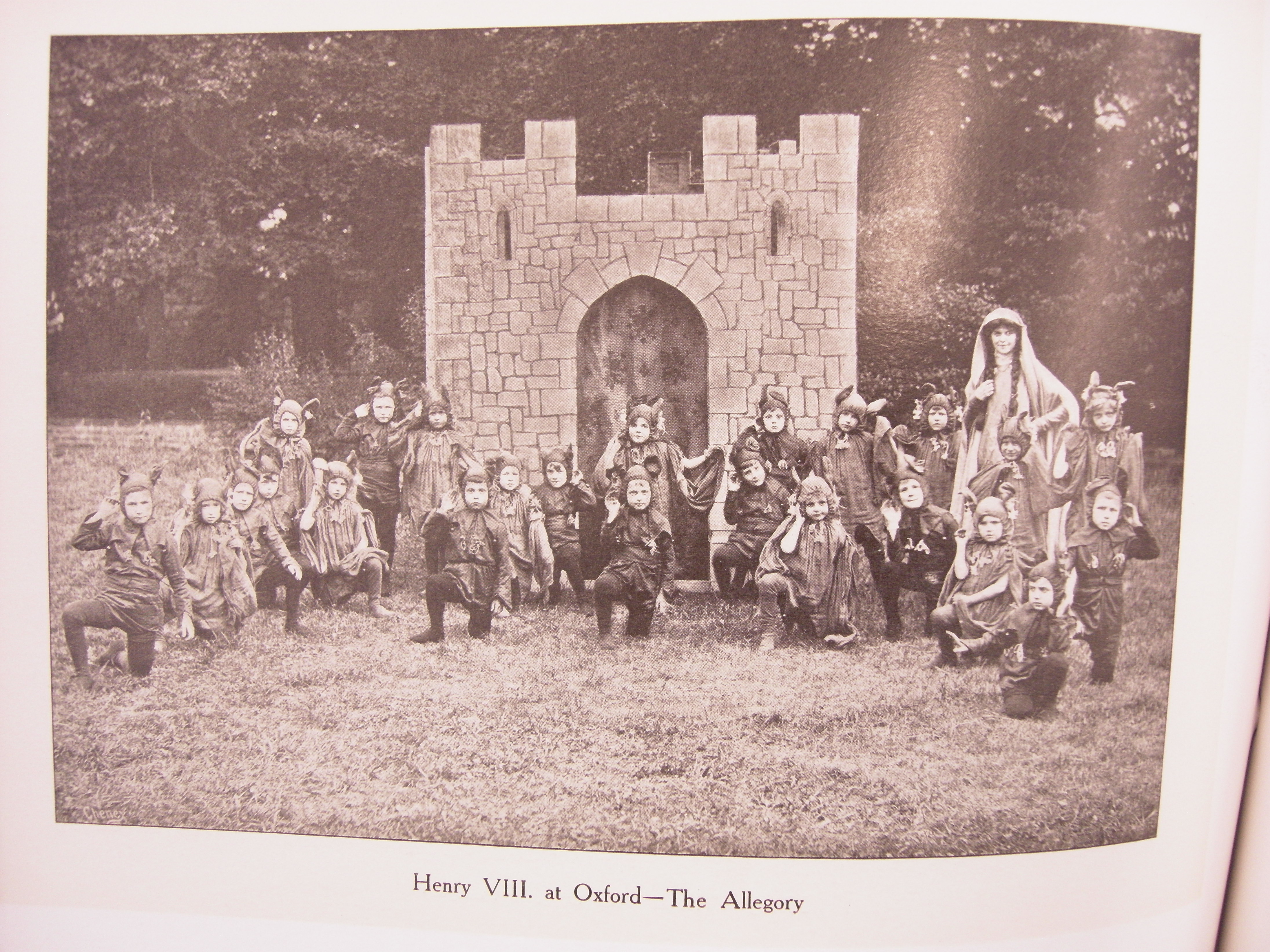
Another lovely example of Cheney & Co’s involvement in local entertainment is a book printed in 1907 to commemorate the Oxford Pageant[13]. The pageant was organised to raise funds for the Radcliffe Infirmary and the Oxford Eye Hospital, and involved the people of Oxford dressing up in historical dress and re-enacting the history of Oxford. My personal highlights are the Vikings landing, Queen Elizabeth and her court being photographed school-photograph style, and a recreation of the St. Scholastica’s Day ‘Town and Gown’ riots!
Bodleian Libraries Cheney c.10
Bodleian Libraries Cheney c.10
Bodleian Libraries Cheney c.10
Bodleian Libraries Cheney c.10
Several volumes of the archive are full of printed ephemera related to politics, further demonstrating the Cheney’s connection with the general public. Some are open letters from MPs at election time. Others record contemporary reaction to political changes, for example some notices refer to the change to a secret ballot in 1872, instructing voters how to cast their vote properly[14]. However, some are perhaps even more relevant to the present day: vicious tirades against fellow MPs[15] , and satires describing the election as a horse-race, with a notice of betting on the contestants, and a summary after the ‘race’[16]. . These satires were published by various different printers in Banbury and the surrounding area, and so the archive demonstrates a wide range of political affiliations, showing elections from several different perspectives. It is interesting to see how, in a world without social media, politics could be equally as cut-throat, and printed ephemera clearly played a very important role in this.
Fashion is another particular strength of the Cheney archive. Several catalogues and pamphlets for different shops can be found, including one for Elliston and Cavell Ltd., the shop that used to be situated at 7-12 Magdalen Street, Oxford, where Debenhams is now[17]. The catalogues offer insight not only into trends for men, women and children, but also into how the fashion trade operated in the 20th century.
Outside of examples of work printed by Cheney and Sons, one manuscript letter[18]
Bodleian Libraries MS. Cheney d.1 (1)
Bodleian Libraries MS. Cheney d.1 (1)
written to ‘Mr Cheney Guild-der’ describes quite a curious commission received by the Cheney firm. Richard Barton asks Cheney to ‘put’ images of angels, Jesus and a small child on two clarinets. The letter is not very professionally written, as the writer starts over three times and runs out of space at the bottom of the page. He also states that he doesn’t want to ask the usual man, because he’s always drunk! This seems quite a strange request to make of a printer – but serves to show another side of the Cheney firm, which was gilding.
Bodleian Libraries Cheney 38
Bodleian Libraries Cheney 18
Bodleian Libraries Cheney 22
Bodleian Libraries Cheney 29
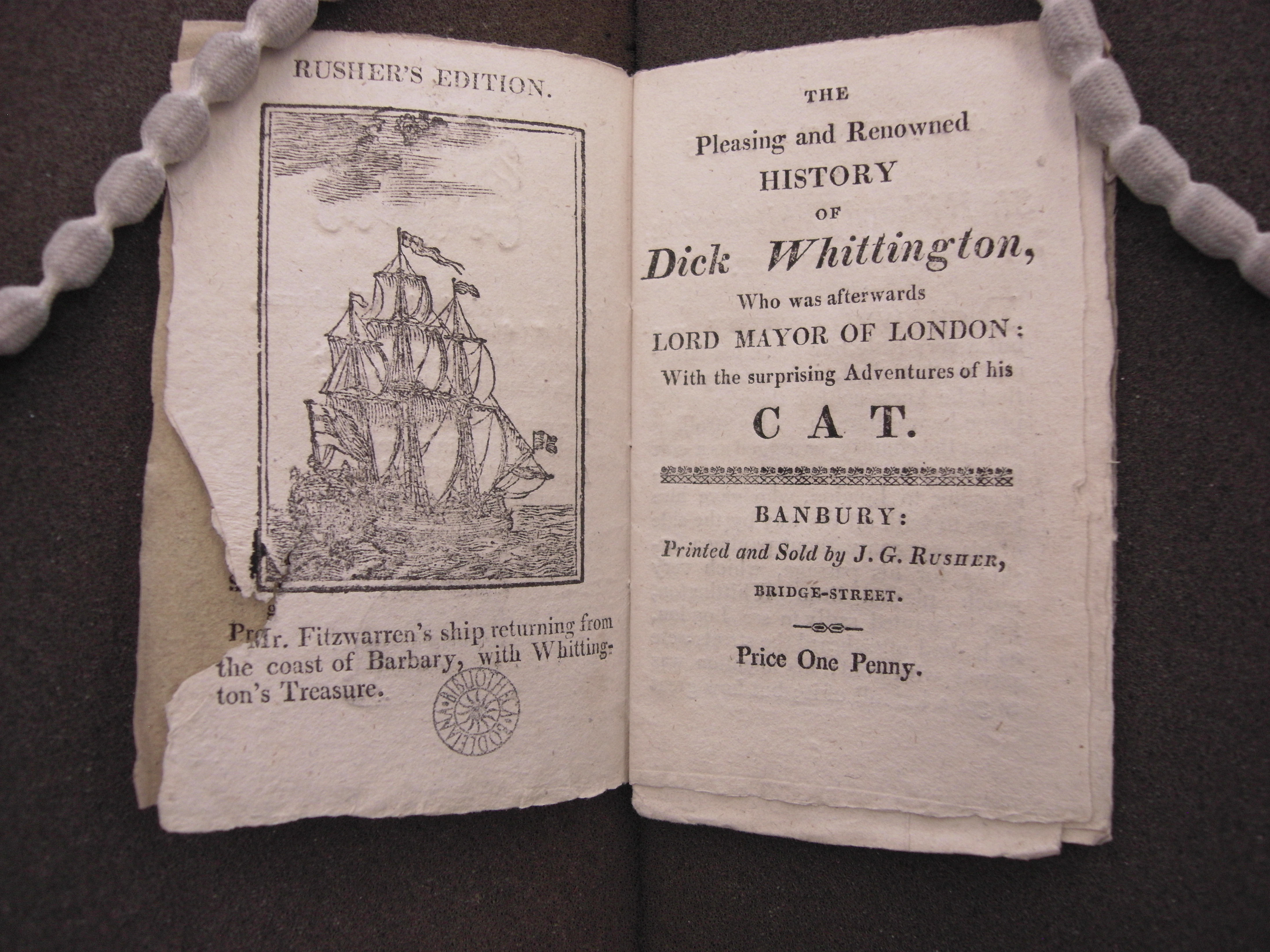
The archive does not just include work by the Cheney firm, though. It also includes the work of other local printers, including J.G. Rusher, who printed a large number of chapbooks in the early nineteenth century. These are small, paper-covered booklets relating children’s stories, folk tales, ballads, poems and riddles, often accompanied by illustrations. Chapbooks were a medium of popular literature in the late 18th and 19th centuries, and the large number of them printed in Banbury by Rusher, Cheney, and other local printers sheds light on the history of production and distribution of such popular literature. Many of the chapbooks relate well-known stories such as Jack the giant killer[19] , Dick Whittington[20] , Cinderella[21], and Jack and Jill[22] , to name but a few.
The range within the Cheney archive material is very broad, as such a lengthy timeframe is likely to afford. Some of the archive material relates to World War II, including notices relating to the blackout and air raids[23]. One notice includes a watermark for ‘Cheney and Sons, Banbury’ . It is clear that the longevity of the Cheney firm stems not only from printing commercially viable popular material, but also from their ability to adapt and change their work to suit current events and extraordinary circumstances.
The archive thus demonstrates the breadth of the uses of print through the late 18th to 21st centuries, and the real integration of a printing firm into every aspect of a community’s life. As we move increasingly further away from a world of print and into a digital age, it is fascinating to see how crucial print has been right up to recent history, and to track some of these changes through one family and printing firm.
The master classes programme presents scholars discussing materials from Bodleian special collections. In 2015-16 the programme included discussions of the letter forms, musical notation, provenance, and artistic content of Bodleian manuscripts and printed books, including the ’12 millionth book’, acquired in 2015, Shelley’s Poetical Essay.
21 October 2015: Stephen Greenblatt (Harvard/Humanitas Visiting Professor) The rise and fall of Adam and Eve
18 January 2016: Irene Ceccherini (Bodleian Library/Lincoln College) The palaeography of the Latin classics in 14th-century Italy
25 Jan 2016: Michael Rossington (Newcastle) Shelley’s Poetical Essay on the Existing State of Things: some manuscript contexts
1 February 2016: Elizabeth Solopova (Faculty of English/Brasenose College) The Wycliffite Bible: beloved but banned bestseller
8 February 2016: Jim McCue (independent) T.S. Eliot, Vivien and ‘F. M.’
15 February 2016: Daniela Mairhofer (University of Vienna) Manuscripts from German religious houses in the Bodleian
22 February 2016: Benjamin Wardhaugh (All Souls, Music) Seventeenth-century musical manuscripts
29 February 2016: Eleanor Giraud (Faculty of Music/Lincoln College) Square chant notation: identifying and distinguishing scribes
7 March 2016: Deirdre Serjeantson (University of Essex, English) Poetic miscellanies from the early modern period
Marginal Malone_Programme. ‘Marginal Malone’, a symposium of the Yale Program in the History of the Book and the Bodleian Libraries Centre for the Study of the Book
This quarto volume is part of the collection of Edmond Malone (1741-1812) whose legacy is celebrated along with that of James Marshall Osborn, at the symposium ‘Marginal Malone’, presented by the Yale Program in the History of the Book and the Bodleian Libraries Centre for the Study of the Book. The symposium webpage is here: http://marginalmalone.com
On the leaf facing the title page is a pen and ink drawing by George Steevens , beneath which is a note by Malone: “Mr. Stevens borrowed this volume from me in 1779, to peruse the Rape of Lucrece in the original edition, of which he was not possessed. When he returned it he made this drawing. I was confined by a sore throat, and was attended by Mr. Atkinson, the apocathary, of whom the above figure whom Shakespeare addresses, is a caricature. E.M. “. To read this note in full see: http://www.rarebookroom.org/Control/shaluc2/index.html. (SOLO record)
(6) The whole contention betweene the two famous houses, Lancaster and Yorke. : With the tragicall ends of the good Duke Humfrey, Richard Duke of Yorke, and King Henrie the sixt. 1619


 Teaching with library material has been continuing at the Bodleian’s Weston Library for Special Collections even as provisions to protect the health of staff and readers have placed restrictions on the numbers and movement of people within the Libraries. Several of the Libraries, including the Weston Library,






 The master classes programme presents scholars discussing materials from Bodleian special collections. In 2015-16 the programme included discussions of the letter forms, musical notation, provenance, and artistic content of Bodleian manuscripts and printed books, including the ’12 millionth book’, acquired in 2015, Shelley’s Poetical Essay.